Safeguarding
What is Safeguarding?
Here at Christ Church, we act in the best interests of all children and promote child welfare (which includes well-being) by:
- protecting them from maltreatment
- preventing impairment of children’s mental and physical health or development
- ensuring that children grow up in circumstances consistent with the provision of safe and effective care
- taking action to enable all children to have the best outcomes
Christ Church, like all schools, has a responsibility and duty of care in keeping children safe. Keeping Children Safe in Education (KCSiE) is the statutory guidance document that schools (and colleges) in England must refer to when carrying out their safeguarding duties. This document backs up several of our policies and procedures (i.e. Behaviour Policy and Safeguarding & Child Protection), which can be found in ‘Key Info’. You can read it here: Keeping children safe in education 2025
It is essential that everybody working in our school, staff, governor, contractors, volunteers alike, understands safeguarding responsibilities. Each year we have specific training about ‘Keeping Children Safe in Education’ (KCSiE) which is monitored by Governors.
Safeguarding permeates every area of school life and is everyone’s responsibility. We work hard to create a culture where children’s voices are heard and where they are prepared for life in Britain. This includes:
- Careful recruitment of staff following KCSiE procedures
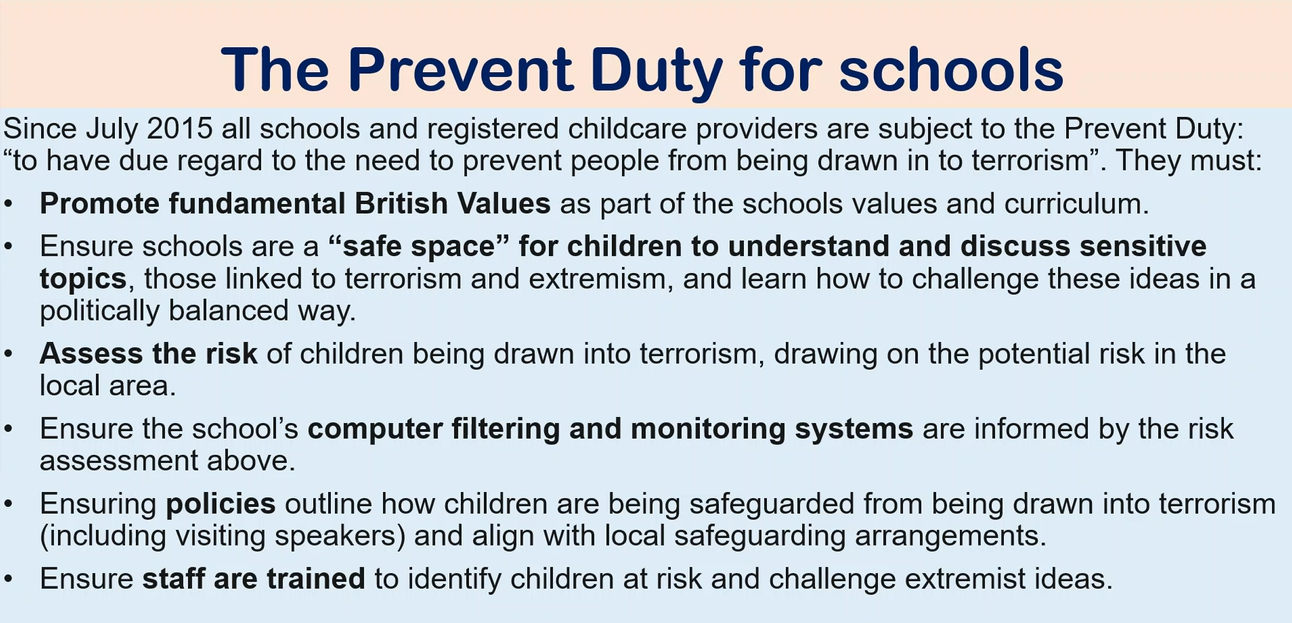
- Preventing children from being radicalised (the ‘Prevent’ duty which is an intrinsic part of safeguarding)
- Thorough record keeping to make sure that staff have the right training (Safeguarding, ‘Prevent’, professional qualifications, First Aid etc) and that this is renewed appropriately
- Buying in expert HR and Safeguarding support from Shropshire Council
- Using CPOMS which is software that monitors safeguarding, well-being, behaviour and pastoral issues and means that information is held confidentially but shared appropriately ensuring we can support children and families
- Regular oversight of our safeguarding procedures by DSL and Deputy DSL and Governors
- Safeguarding is part of every staff meeting ensuring that we are developing a whole school ethos
- Using an excellent PSHE curriculum to ensure that children know their rights and responsibilities and are educated on areas such as ‘consent’ and bullying
- Promoting e-safety, not just as an intrinsic part of Computing, but as applicable in every subject area and working with families to equip children to navigate the online world safely when they are at home
- Promoting positive relationships with children so that they feel safe at school and have trusted adults to talk to, if they have concerns
We have a Designated Safeguarding Lead (DSL): Emma Clarke and two Deputy DSLs: Lindsay Douch and Amy Martin. We have a Link Governor for Safeguarding and the Prevent Duty: Carole Fenton. Anyone in school with any concern about a child or adult is asked to speak to Emma, Lindsay or Amy immediately. Our Safeguarding Governor monitors and critically assesses what we are doing to make sure that we are providing an environment where all children are safe and can flourish.
You can read our Safeguarding Policy in full here: Schools Safeguarding and Child Protection Policy 2024-2025
We are committed to working with parents to safeguard children in all aspects of life, not just whilst they are in school: by teaching them to cross the road safely through Pedestrian Training, cycle confidently and safely through Bikeability and navigate their online world safely when using devices at home. Parents recently attended an NSPCC workshop on online harm and were directed to helpful websites such as CEOP Safety Centre, Childline and Nspcc Online Safety Hub.
You can read more about our approach to online safety here: E-Safety and Online Safety Policy 2024-25 (KCSiE)
Mental Health and Emotional Well-Being
We have a Mental Health Lead, Lindsay Douch who works hard to ensure that mental health is spoken of openly and that we have a culture and ethos of valuing well-being. You can find out more: Social, Emotional and Mental Health (SEMH) Policy
Click How-to-Help-Children – questions parents can ask for some great questions and tips about how to ask your child about their school day and help them to reflect on their learning. If you are worried about your child’s emotional and mental well-being – then please do chat to us. The NHS has an excellent support page for parents at https://thismayhelp.me/ where parents can find out information about:
- Children’s mental health
- Online activity and gaming
- Self harm
- Eating disorders
- Teenager safety
- Eating Disorders
You may also find some useful resources in this toolkit: https://citymha.org.uk/Resources/Parents-Toolkit
Online Safety and Support for Parents
There are some helpful NSPCC resources here: NSPCC_OnlineSafetyWorkshop_Factsheet NSPCC_OnlineSafetyWorkshop_ResourceSheet
In school we also have robust filtering and monitoring of our computer systems through Shropshire IT which complies with our duties under Keeping Children Safe in Education: Smoothwall filtering +KCSIE
Emma Clarke as Head of School receives reports from filtering software and is able to take action if we have a concern about acceptable usage.
Preventing Radicalisation
We have a legal duty to prevent children from being radicalised into terrorism as this poses a safeguarding risk to the child and to others. You can find out more here: Prevent_Duty Policy Aut 24-27
Domestic Abuse -recognise domestic abuse
Does your partner, ex-partner or someone you live with:
- cut you off from family and friends and intentionally isolate you?
- bully, threaten, or control you?
- take control of your finances?
- monitor or limit your use of technology?
- physically and/or sexually abuse you?
Domestic abuse is not always physical violence. It can also include:
- coercive control and ‘gaslighting’
- economic abuse
- online abuse
- threats and intimidation
- emotional abuse
- sexual abuse
Anyone can be a victim of domestic abuse, regardless of gender, age, ethnicity, religion, socio-economic status, sexuality or background.
If you believe that you are a victim of domestic abuse, there are signs that you can look out for including:
- being withdrawn, or being isolated from your family and friends
- having bruises, burns or bite marks on you
- having your finances controlled, or not being given enough to buy food, medication or pay bills
- not being allowed to leave your house, or stopped from going to college or work
- having your internet or social media use monitored, or someone else reading your texts, emails or letters
- being repeatedly belittled, put down or told you are worthless
- being pressured into sex or sexual contact
- being told that abuse is your fault, or that you’re overreacting
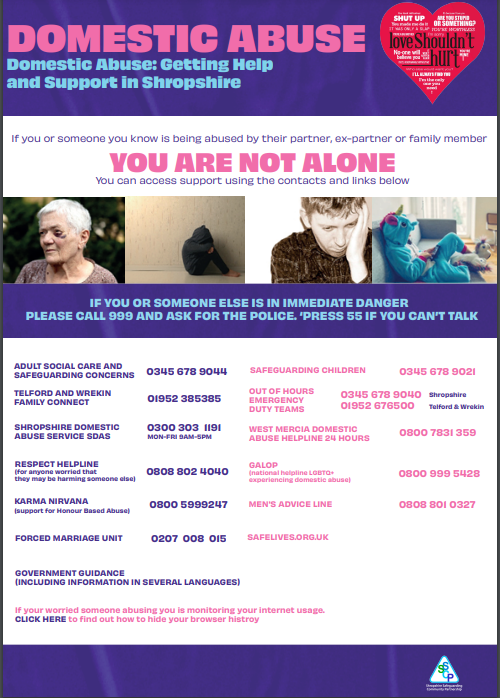
School can be an important partner in helping you get support and we also have a duty to children who are also victims of domestic abuse when it is going on between their caregivers. There is a lot of information you can access at a convenient time here: Government advice on domestic abuse and how to get help and there are also local numbers of support groups here: Local domestic abuse partnership. School are always happy to support you in this area – please don’t feel embarassed to speak to us about it as domestic abuse happens in all kinds of families from all types of backgrounds. If you have concerns that a partner or potential partner might have been a perpetrator of domestic abuse in the past, then you can contact the police for some checks. More details are here: Clare’s Law Leaflet
Contact NSPCC if you have concerns about a child
Click below to go to Shropshire Safeguarding Community Partnership
Click below for NSPCC Online Safety
Domestic Abuse Advice
Concerned about Neglect?

Protecting Children from Radicalisation